
Air Circulation vs. Natural Ventilation
These two get confused constantly, and mixing them up is one of the most common reasons a greenhouse or high tunnel underperforms. Here’s the actual difference, and why you usually need both.
Home » Greenhouse Ventilation » Air Circulation vs Natural Ventilation
On this page
Ventilation vs. Circulation
The two aren’t substitutes for each other. Ventilate without circulating, and you’ll get pockets that never benefit from the air exchange happening elsewhere in the structure. Circulate without ventilating, and the whole building gets hot and humid together, since you’re just moving the same stale air around — which stresses plants and invites disease.
Ventilation is the active exchange of indoor air for outside air. It’s what removes heat and humidity from the structure and replaces it with cooler, drier air from outside — and it’s also what replenishes the CO2 that gets consumed during photosynthesis. Ventilation typically comes from end-wall exhaust fans paired with intake louvers, passive ridge or peak vents paired with roll-up sides, roll-up sides alone in a location with a reliable crosswind, or even large doors on each end wall.
Circulation, by contrast, just mixes the air that’s already inside — usually with horizontal airflow (HAF) fans. Circulation is what ensures every square foot of growing space gets roughly the same conditions, eliminating the dead zones (often corners) that ventilation alone tends to leave behind.
Active vs. Passive Systems
Active Systems
Active systems use electric motors to spin fans and move air, which means they need electricity and their practicality depends on where the structure sits. A typical active setup: two exhaust fans on one end wall, two intake louvers on the opposite end wall, and a thermostat that opens the louvers and switches on the fans once temperature crosses 85°F.
Passive Systems
Passive systems rely on openings in the structure itself to create natural airflow. They’re often preferred for their lower upfront cost, energy efficiency, and installation flexibility — no electric utilities required. The tradeoff is that passive systems depend on consistent, gentle prevailing winds, so avoid siting them too close to large structures, dense tree lines, or anything else that blocks airflow.
How Much Airflow You Actually Need
For hot-season growing, plan on 8 CFM per square foot of growing space; for cooler-season growing, 2 CFM per square foot. For a 30 ft × 96 ft tunnel (roughly 2,900 sq ft of growing area), that works out to 23,200 CFM for hot season and 5,800 CFM for cool season. If a structure runs year-round, two ventilation stages controlled by a two-stage thermostat — or variable-speed fan control — let you adjust the flow rate as seasons change.
For circulation, the target is different: 25% of total growth volume per minute (per Bartok and Aldrich’s Greenhouse Engineering). A 30 ft × 96 ft tunnel with a 15 ft peak has roughly 34,000 cubic feet of volume, so one-quarter of that — about 8,500 CFM — is the HAF flow rate you’re aiming for.
Exhaust Fans and Inlet Louvers
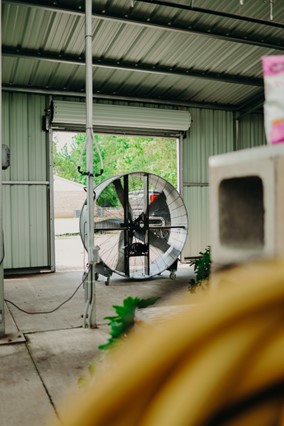
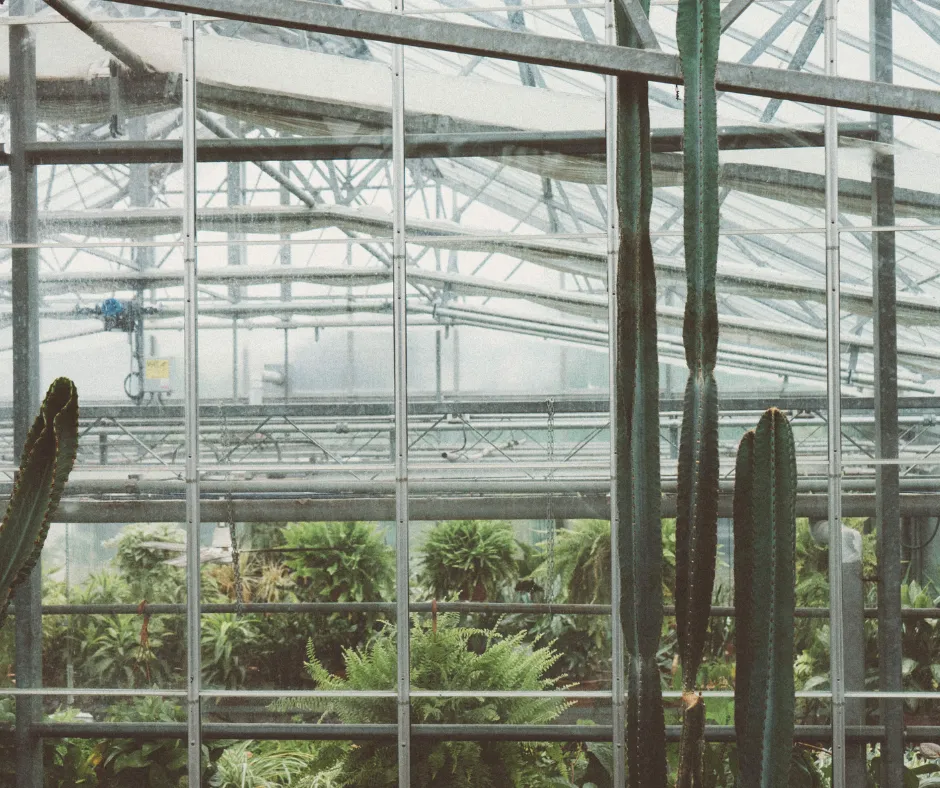
Exhaust ventilation fans run 12″ to 48″ in diameter, cost $200-$1,000 each, and move 1,000-22,000 CFM. They can be direct- or belt-driven, and run at single, dual, or variable speed — multiple fans with staged temperature controls let you build in more than one ventilation level for different seasons. Fans are usually mounted on a common endwall, with matching inlet louvers on the opposite wall to create sweeping airflow; louver area should match fan area. Motorized louvers with a flange (running $50-$250) are worth the extra cost — they improve energy efficiency and reduce drafts, and are usually wired to the same control circuit as the fans so the inlet opens automatically when the fans switch on.
Roll-Up Sides
Depending on location, prevailing wind, and whatever other vents are in play, roll-up sides can act as either an inlet or an outlet. The mechanism is plastic sheeting run the length of the tunnel and rolled up around a pipe to whatever opening you need — either by hand crank, or with our curtain motors for automated control.
Ridge, Peak, and Gable Vents
Ridge vents and peak vents are roof sections that open to let warm, humid air escape from the top of the structure. Ridge vents rise from one side of the tunnel and end above the other at the ridge, leaving a vertical segment that opens and closes; peak vents run the length of a Gothic-style roof and open the same way. Both are effective alternatives to exhaust fans, and when paired with roll-up sides, can deliver quiet, energy-efficient ventilation that’s usually the cheapest option to install when the structure is first built. They run on a motor and rack-and-pinion system, adjustable to different opening levels based on temperature and your control system.
Gable vents sit at the top of the end wall and work as a passive option, particularly useful alongside roll-up sides.
Horizontal Air Flow (HAF) Fans
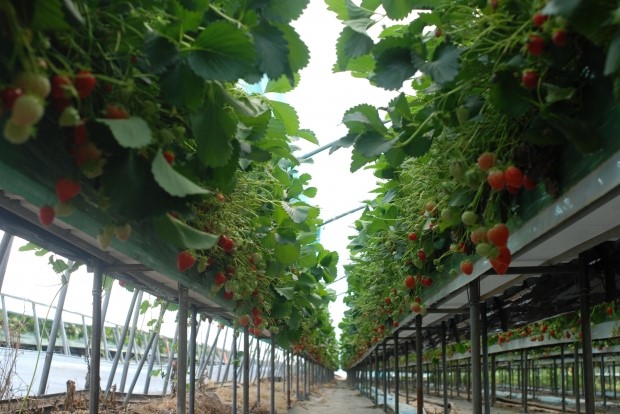
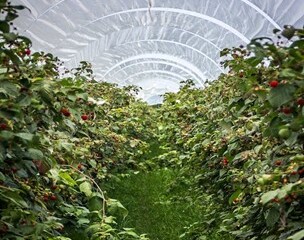
HAF fans typically run 12″ to 24″ in diameter, cost $80-$300, and move 1,000-5,250 CFM. Some growers get by with cheaper box fans — they need replacing more often and you need more of them, but the upfront cost is lower. HAF fans deliver their rated flow only over a specific “throw” distance, so spacing matters: the general rule is one fan every 50 feet, though in practice 20-30 feet is more realistic, especially with dense crops like tomatoes or cucumbers. A “racetrack” layout (fans oriented to circulate air around the perimeter) is the standard configuration, though even a good layout often leaves a couple of corners with lower flow — worth testing before finalizing.
Heaters and Airflow
Heaters aren’t strictly a ventilation topic, but they matter for humidity control: heated air holds more moisture, so ventilation airflow removes humidity more efficiently when the air moving through is warm. Sizing a heater depends on structure size, target inside temperature, outside temperature, and how well-sealed the tunnel envelope is.
Controls: Switches, Thermostats, and Environmental Controllers
Switches are the simplest control — inexpensive, easy to install, but they need someone to physically flip them. It’s common to put ventilation fans and HAF fans on separate switches for more operational flexibility.
Thermostats automate that decision, opening or closing based on a temperature setpoint — configured to close on falling temperature for heating, or close on rising temperature for cooling. The sensing probe should ideally be aspirated (air moving over it), shielded from direct sunlight, and positioned where it actually reflects what the plants are experiencing.
Environmental controllers go further, monitoring multiple inputs (temperature, humidity) to manage multiple outputs at once. These used to be out of reach for smaller operations, but prices have come down significantly, and they’re now practical for automating more complex setups — heating, ventilation fans, circulation fans, roll-up sides, even irrigation — typically with computer or smartphone access for checking conditions and adjusting setpoints remotely. Our environmental control systems are built for exactly this kind of multi-system automation.
Common Mistakes
1. Inadequate Ventilation
If exhaust fans are running constantly, or every passive vent is wide open, and temperatures are still too high, ventilation is undersized. Widespread fungal disease is another strong signal. Ventilation effectiveness also shifts through the season as plants grow and start blocking airflow — standing in the middle of the tunnel should feel like a comfortable breeze; if it doesn’t, something’s off.
2. Inadequate Circulation
Poor circulation shows up as inconsistency: hot spots, cool spots, humid pockets, condensation. Watch for leaf movement throughout the space, or hang cut strips of survey tape from the framing — they’ll show you exactly where air is and isn’t moving.
3. Automation vs. Labor
Monitoring a high tunnel or greenhouse by hand takes real time and attention. A full environmental control setup — controller, sensors, roll-up motors, on top of existing fans — typically runs $1,500-$3,000. At $20/hour labor and 15 minutes of manual checking per house, twice a day, that system pays for itself in around 250 growing days.
Not Sure If You Need More Ventilation or More Circulation?
Most structures that feel like they're "fighting the weather" actually have one of these two dialed in and the other neglected. Tell us what you're seeing — hot corners, condensation, fans running nonstop — and we'll help you figure out which side of this needs the fix.